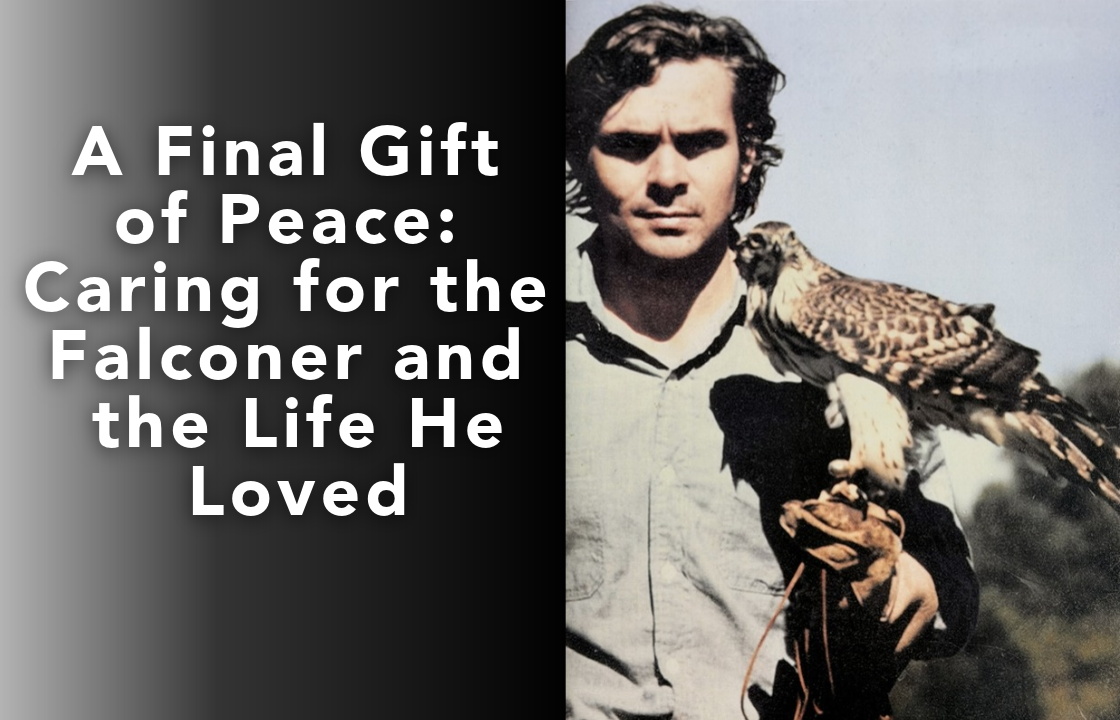
For most of his life, Ron was rarely without a falcon.
His fascination with falconry began when he was about 12 years old, spending summers with his grandmother in Northern Virginia. A master falconer who lived nearby introduced him to the practice, and something clicked.
“It just hooked him when he was a child, and it never let go,” his wife, Patsy, said.
There was only one significant pause.
At 17, Ron joined the U.S. Navy, driven by another childhood fascination: ships. For nearly four years, he served aboard the USS Robert A. Owens and traveled extensively while in the service. Even then, falconry was never far from his mind. During time in Mediterranean countries where falconry had a strong tradition, Patsy said Ron was fascinated by the way others practiced the craft.
When his Navy service ended, he returned home and returned to his birds.
Falconry would remain part of his life until his death.
A Life Built Around Falconry
Over the years, Ron became well known in Culpeper and among falconers across several states. He raised and trained birds, traveled to falconry meets, hunted with them and crafted intricate leather hoods by hand.
He also shared what he knew. When local elementary school students read a book involving falconry, Ron would visit and take one of his birds. Patsy remembers the children loving those visits, and Ron sometimes left with invitations to new places to fly his falcons from families he met through the schools.
Falconry wasn’t something Ron could simply pick up when he felt like it. Caring for and training the birds required daily attention, and that rhythm shaped much of the life he and Patsy built together.
She learned that almost immediately.
On their first date in 1988, after attending a local barbecue, Ron told her he needed to stop and check on his new falcon. Would she like to come?
Patsy wasn’t quite sure what she was getting herself into.
But she went.
Nearly 40 years together followed, with falconry woven through it all. Vacations and other plans were scheduled around falconry season. They even traveled to London on their honeymoon and visited a falconry center.
“Everything we did revolved around falconry,” Patsy said.
Ron built a life that gave him room for the things that mattered to him. In addition to falconry, he was a well-respected general contractor who built and remodeled homes. Patsy remembers him as someone with a strong work ethic who loved being outdoors, working with his hands and staying busy.
Even as his illness progressed, that part of him remained.
Some of their last conversations were about how much he missed working and wished he could get back to it.
“He had Parkinson’s disease, but he didn’t let it define his life,” Patsy said.
Caring for What Mattered Most
As Ron’s health declined, one question became especially difficult for Patsy: What would happen to his falcon?
The bird was federally banded, had lived its entire life in Ron’s hawk house and required someone with the knowledge and experience to safely take over its care.
Patsy and Ron had talked about it months earlier, but they never settled on exactly who should take the bird. As his condition worsened, the responsibility weighed on her.
Then the Hospice of the Piedmont team learned about Ron’s falconry.
When one of his hospice nurses came to the house and noticed the building where Ron kept his bird, Patsy explained what it was and shared her worry about finding the falcon a new home.
Later, during a visit with Dr. Kell Mitchell, a physician with Hospice of the Piedmont, they told Patsy they knew falconers in Virginia.
It turned out they were people Ron and Patsy already knew through the falconry community.
The connection was made. Within days, experienced falconers came to the house, safely collected Ron’s bird and arranged for it to go to someone who would be a good match.
To Patsy, the timing felt like far more than coincidence.
“That was a sign from God,” she said.
But perhaps most meaningful was that Ron was still there when Patsy was able to tell him his falcon would be cared for.
“I said, ‘Ron, you remember Andrew and Eva? They’re going to come and get the bird,’” Patsy recalled. “I think that gave him the peace that he needed.”
Ron died soon afterward, at home, with Patsy beside him.
For a man whose life had revolved around his birds for decades, knowing that his final falcon would be in experienced hands offered something medicine alone could not provide.
And it provided something important for Patsy, too.
“That’s something that will always stick with me,” she said.
“There Are No Words to Describe the Help and the Peace”
The falcon was one part of the care Patsy remembers. Just as important was the way the Hospice of the Piedmont team supported her as Ron’s caregiver.
As his needs increased, tasks Patsy had once managed became impossible to handle on her own. Hospice team members helped with his personal care, medications, equipment and comfort. They also helped Patsy understand the changes she was seeing and what they might mean.
“They had the awareness of his condition,” she said. “There are no words to describe the help and the peace that you have when they come and they help you.”
Ron was able to remain at home, in the place he knew, close to Patsy and close to the hawk house that represented so much of the life he had built.
For Patsy, that mattered.
“The Sooner, the Better”
Today, when Patsy talks with someone who may be considering hospice for themselves or someone they love, her advice is straightforward:
“Get them as soon as you can. And just let them do what they do.”
Before experiencing it herself, Patsy said she did not fully understand everything hospice could provide. Now, she wants other families to understand that accepting hospice care opens the door to support and guidance you don’t even know you need.
“No matter how strong you are, no matter how many family members you have, those last weeks especially, you have to have the help,” she said.
For Patsy, the team didn’t only see Ron as a patient. They got to know the person who had served in the Navy, built homes in his community, loved children, traveled the world with Patsy and devoted most of his life to falconry.
The Hospice of the Piedmont care team understood that the bird in the hawk house wasn’t simply a problem that needed to be solved. It was connected to a passion that had begun when Ron was a boy and had stayed with him through nearly every chapter of his life.
And when Ron could no longer care for that part of his world himself, they helped Patsy find someone who could.
“That team was just amazing,” she said. “I don’t think I could have gotten through it by myself.”
If you or your loved one is in need of support, let’s start the conversation.